You Won’t Believe What I Ate in Battambang
Battambang, Cambodia’s quiet gem, isn’t just about colonial architecture and bamboo trains—its food scene hits different. I went not knowing what to expect, and left completely obsessed. From smoky street grills to hidden market stalls dishing out generations-old recipes, every bite told a story. This is more than hunger satisfaction—it’s cultural connection on a plate. If you think Cambodian food stops at amok, think again.
Arrival in Battambang: First Impressions of a Laid-Back Food Haven
Battambang greets visitors with a gentle rhythm, a city that moves to the beat of bicycle bells and the slow churn of river life along the Sangker. Unlike the bustling streets of Phnom Penh or the tourist-thick alleys of Siem Reap, this provincial capital exudes a calm authenticity. French colonial villas with peeling pastel paint lean gently beside wooden shophouses, their shutters thrown open to the morning heat. There’s no rush here, no aggressive tuk-tuk touts shouting for business—just the soft hum of daily life unfolding at a human pace.
This unhurried atmosphere extends directly into the way food is made and enjoyed. Meals are not consumed between meetings or rushed bites before sightseeing. Instead, they are moments to pause, to gather, to savor. My first meal in Battambang set the tone: a simple bowl of *kuy teav*, a clear pork-based noodle soup, served from a weathered cart tucked beside a quiet alley near the central market. The vendor, an older woman with hands shaped by decades of stirring steaming pots, ladled broth over thin rice noodles with practiced grace. A sprinkle of fried garlic, fresh bean sprouts, and a squeeze of lime transformed the bowl into something quietly extraordinary.
What struck me most was not just the flavor—clean, savory, subtly spiced—but the care behind it. The broth had simmered since before dawn. The herbs were cut just minutes before serving. Nothing was prepped in bulk or reheated under heat lamps. This attention to freshness and timing, I would soon learn, is not an exception in Battambang. It is the standard. The city’s slower tempo allows space for culinary patience, a luxury often lost in more commercialized destinations. Here, food isn’t fast because life isn’t either.
The Heart of Local Flavor: Exploring Battambang’s Morning Market
By 6 a.m., Psar Nat, Battambang’s main market, is already alive with energy. The air hums with chatter, the clatter of cleavers on wooden boards, and the rich, layered scent of fermenting fish, fresh herbs, and grilled meats. Sunlight filters through the corrugated tin roof, casting stripes across piles of bright green morning glory, knobby turmeric roots, and baskets of tiny eggplants no bigger than a thumb. This is where Battambang feeds itself—and where a visitor can truly understand the ingredients that define Khmer cuisine.
At the heart of the market’s identity is *prahok*, the pungent fermented fish paste that acts as the umami backbone of many Cambodian dishes. Sold in small plastic bags or stacked in earthenware jars, it’s a flavor that surprises first-time tasters but soon becomes essential. Vendors proudly display their homemade batches, each family guarding their unique method of salting, fermenting, and aging. Alongside it, you’ll find banana blossoms, sliced thin for salads, and wild river herbs with names rarely translated—*sladap*, *chi krasang*—that add a peppery depth to soups and stews.
One stall, run by a woman named Srey Pov (as shared by a local guide), specializes in *bok l’ong chheu teuk*, a lesser-known noodle soup unique to this region. The broth is light but deeply aromatic, infused with lemongrass, galangal, and kaffir lime leaves, then enriched with a touch of coconut milk and minced pork. Rice noodles are topped with poached chicken, a boiled egg, and a tangle of fresh herbs. She serves it from a clay pot that has been passed down through three generations, the vessel itself contributing to the soup’s even heat and subtle earthiness.
Markets like Psar Nat are more than places to buy food—they are social anchors. Neighbors meet here daily, exchanging news over shared plates of steamed rice cakes wrapped in banana leaves. Elderly women squat on low stools, shelling peas for the afternoon’s curry. Children dart between stalls, grabbing sticky rice balls as snacks. To eat here is to participate in the rhythm of Cambodian domestic life. There are no menus translated for tourists, no Instagrammable plating—just honest, nourishing food made with pride and purpose.
Street Food Adventures After Dark: Where Locals Eat
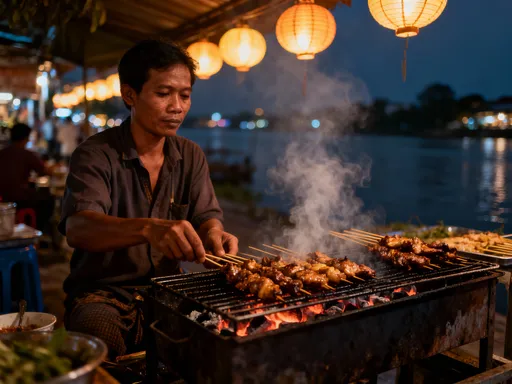
As the sun dips behind the Cardamom foothills, Battambang’s riverside transforms. Folding tables and plastic stools appear along the Sangker Riverbank, and smoke begins to curl from charcoal grills. This is when the city’s true street food culture comes alive—not for tourists, but for locals ending their day with friends and family. The menu is bold, smoky, and deeply satisfying.
One of the most talked-about offerings? Grilled frog legs, marinated in garlic, turmeric, and soy sauce, then cooked over open flame until the skin crisps and the meat turns tender. At first, the idea gave me pause, but one bite changed my mind. The flavor was delicate, almost chicken-like, with a subtle sweetness from the marinade and a hint of smokiness from the charcoal. Beside it, skewers of pork belly glisten with a sticky glaze of palm sugar and fish sauce, caramelizing at the edges. And then there’s *sticky rice in bamboo*—glutinous rice slowly steamed inside fresh bamboo tubes, absorbing the woody aroma of the vessel and often mixed with black beans or coconut cream.
I sat at a crowded table with a group of young locals who welcomed me with shy smiles. They guided me through the spread: dip the grilled meats in *tuk trey*, a tangy dipping sauce made with lime, chili, and fish sauce; wrap bites in fresh lettuce leaves to cut the richness; drink cool sugarcane juice to balance the heat. The experience was less about novelty and more about community. Every dish was shared, passed hand to hand, with laughter and gentle teasing.
For travelers, eating street food safely comes down to observation. Look for stalls with high turnover—busy means fresh. Watch how food is handled: is it cooked to order over flame? Are raw and cooked items kept separate? In Battambang, most vendors follow these practices instinctively. The risk isn’t in the food itself, but in straying from the crowd. The busiest stalls are busy for a reason: they’re trusted. And while some dishes may seem daring, the real adventure lies not in shock value, but in openness—approaching each bite with respect, not bravado.
Hidden Eateries & Family-Run Spots Off the Tourist Map
Some of the best meals in Battambang aren’t listed on any app. They’re found down narrow lanes, in homes where the front room doubles as a dining area, and where the menu is whatever the family cooked for themselves that day. One such place, recommended by a tuk-tuk driver named Vannak, is a modest home kitchen run by an elderly couple for over thirty years. There’s no sign, no English menu—just a few tables under a shaded courtyard, and the scent of banana leaves on the grill.
Their specialty: *sach ko ang*, marinated beef grilled in banana leaves. The meat is rubbed with a paste of lemongrass, garlic, turmeric, and a touch of soy, then wrapped tightly and slow-cooked over low charcoal. When unwrapped, the beef is tender, fragrant, and infused with the sweet, earthy aroma of the leaf. It’s served with a side of *papaya salad*—not the Thai-style spicy version, but a milder Cambodian rendition with green mango, crushed peanuts, and a dressing balanced between sour and savory.
What makes this place special isn’t just the food, but the welcome. The woman of the house, wearing a faded cotton blouse, brought tea without being asked and sat briefly to ensure I was comfortable. There was no expectation of a large tip or social media post. This was hospitality rooted in Khmer values—*somnong*, or kindness—offered freely. In a world where authenticity is often staged for cameras, this felt real.
Such spots are found through conversation, not apps. Ask your guesthouse owner, your tuk-tuk driver, or the vendor at the market where they eat. Learn a few basic Khmer phrases: *Ahn thngai leor?* (How much?) or *Ahn kar kor dai?* (Can I have this?). These small efforts signal respect, and in return, you’re more likely to be guided to places where the food is made not for show, but for love. These family-run kitchens aren’t trying to impress—they’re simply living, and sharing their table with those who show genuine interest.
Traditional Techniques: How Food Preserves Culture in Battambang
In Battambang, cooking is not just about feeding the body—it’s an act of cultural preservation. The methods used in home kitchens and village stalls have changed little over generations. Clay pots, passed down like heirlooms, are still used to simmer broths slowly, allowing flavors to deepen without scorching. Wood-fired stoves provide steady, radiant heat ideal for grilling and steaming. And stone mortars and pestles—*sak* and *ou*—are used daily to grind spices, herbs, and pastes, releasing essential oils in a way electric blenders cannot replicate.
These techniques are more than practical; they are vessels of memory. A grandmother grinding lemongrass and kaffir lime leaves isn’t just preparing dinner—she’s passing down a sensory legacy. Recipes in rural Cambodia are rarely written. They are taught by doing, through observation and repetition. A young girl learns to adjust the salt in a soup by watching her mother’s face, not by measuring spoons. This oral tradition keeps Khmer cuisine alive in its most authentic form.
Seasonal dishes also reflect the agricultural calendar. During the rainy season, *fish amok* might include freshwater fish caught from flooded rice paddies. In the dry months, preserved vegetables and dried meats become staples. Festivals bring their own specialties—sticky rice cakes for Pchum Ben, sweet coconut pancakes for Khmer New Year. Each dish ties the people to the land and the cycles of nature.
Even in the face of modernization, these traditions endure. In Battambang, where tourism remains low-key compared to other regions, there’s less pressure to adapt or simplify. The food stays true. When you taste a dish cooked in a clay pot over wood fire, you’re not just eating—you’re connecting to centuries of resilience, resourcefulness, and quiet pride. The flavors carry history, and every bite is a small act of cultural continuity.
Beyond Taste: The Ethics and Sustainability of Eating Local
Traveling through Battambang’s food scene comes with a quiet responsibility. With every meal, you’re making a choice—supporting a family-run stall or a foreign-owned café, buying local produce or imported ingredients. The most ethical and sustainable choice is often the simplest: eat where locals eat, especially at small, independent vendors.
These micro-businesses operate on thin margins. A few extra customers a day can make a real difference. By choosing a sidewalk noodle cart over a branded riverside restaurant, you’re ensuring that your money stays in the community. These vendors source ingredients from nearby farms and markets, minimizing transport and packaging. Food waste is nearly nonexistent—leftover rice becomes tomorrow’s porridge, vegetable scraps feed livestock, and banana leaves are composted or reused.
Respectful engagement goes beyond economics. Take time to learn the names of dishes, even if pronunciation is imperfect. Smile, point, use basic gestures. A simple *awk-koon* (thank you) in Khmer can brighten someone’s day. Avoid treating food as a spectacle. Taking photos is fine, but ask first, and never mock or sensationalize what’s on someone’s plate. Eating grilled frogs or fermented fish isn’t about being adventurous for the sake of a story—it’s about honoring a cuisine that has sustained a people for generations.
True sustainability also means slowing down. Don’t rush through a meal just to check it off a list. Sit. Observe. Let the vendor pour you tea. Share a smile. When you eat with intention, you transform consumption into connection. You’re no longer a spectator—you’re a guest, welcomed into a culture one plate at a time.
How to Experience Battambang’s Food Culture Like a Local
To truly appreciate Battambang’s culinary soul, approach it like a resident, not a checklist tourist. Start early. The morning market is at its most vibrant between 6:00 and 8:00 a.m., when vendors are restocking and the day’s cooking begins. Arrive with an empty stomach and an open mind. Look for stalls with locals already seated—this is the best indicator of quality and freshness.
For a full-day food journey, begin at Psar Nat with a bowl of *kuy teav* or *bok l’ong chheu teuk*. By midday, wander the side streets for snacks: steamed banana cakes wrapped in banana leaves, or *num pang*—Cambodian baguettes filled with pâté, cucumber, and chili. In the late afternoon, rest in a shaded café with strong iced coffee sweetened with condensed milk. Then, as evening falls, head to the riverfront for grilled meats and sticky rice in bamboo.
Practical tips matter. Carry small bills—vendors rarely have change for large notes. Bring tissues and hand sanitizer, as restrooms may be basic. Be mindful with photography: smile first, ask with a nod, and never photograph someone without permission. Dress modestly out of respect, especially when entering homes or family-run eateries.
Most importantly, slow down. Let meals unfold over time. Sit longer than feels normal. Accept a second cup of tea. Allow conversations to happen, even if language is a barrier. In Battambang, food is not a transaction—it’s an invitation. When you accept it with humility and curiosity, you’re not just tasting Cambodia. You’re becoming part of its story.
More Than a Meal—A Taste of Cambodia’s Soul
Battambang doesn’t shout about its treasures. It whispers them—in the clink of a ladle against a clay pot, in the scent of lemongrass on the evening air, in the quiet nod of a vendor who hands you a spoon without being asked. Its food culture is not performative. It is lived, shared, and deeply rooted in place and people.
Every dish here carries more than flavor. It carries memory. It carries resilience. It carries the quiet dignity of a culture that has preserved its identity through generations of change. To eat in Battambang is to participate in that preservation—not as a spectator, but as a guest welcomed into the kitchen, the market, the family table.
This is the power of food as cultural bridge. It asks nothing of you but presence and respect. In return, it offers connection—real, unfiltered, and deeply human. So when you travel, go beyond the sights. Sit down. Taste slowly. Listen to the stories behind the food. Because in Battambang, every meal is an act of sharing, and every bite is a step toward understanding. This isn’t just travel. It’s transformation—one humble plate at a time.